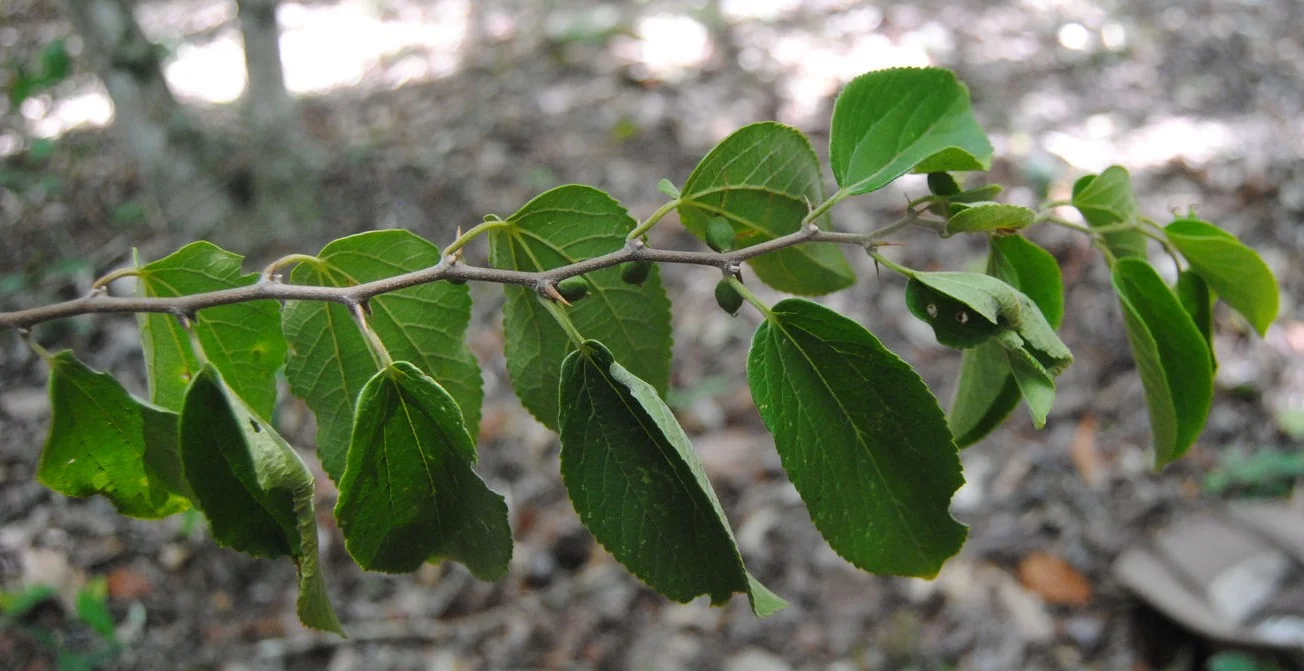
Widely distributed across South America, Celtis brasiliensis flourishes as a versatile woody plant adapted to diverse climates. Commonly referred to as the Brazilian hackberry, it was scientifically classified by Jules Émile Planchon based on earlier botanical collections by George Gardner.
This member of the Cannabaceae family successfully adapts to multiple environmental conditions, growing naturally in regions spanning from Colombia and Peru down to Argentina and Brazil.
Celtis brasiliensis exhibits a flexible growth habit, developing either as a deciduous tree or a scrambling shrub. Mature specimens typically reach heights ranging from 1.5 to 10 meters.
The plant sheds its leaves seasonally, a characteristic behavior for this climate zone. Its foliage presents typical alternate leaf arrangements that support effective photosynthesis in diverse South American environments.
Interesting facts
The initial scientific description of this species is attributed to the Scottish botanist George Gardner, but was validly published by Jules Émile Planchon in 1848.
Due to its sometimes extremely climbing growth habit, the plant can form dense thickets that are almost impenetrable to larger mammals.
It tolerates a wide range of climate zones, from the tropical foothills of the Andes to the subtropical regions of southern Brazil.