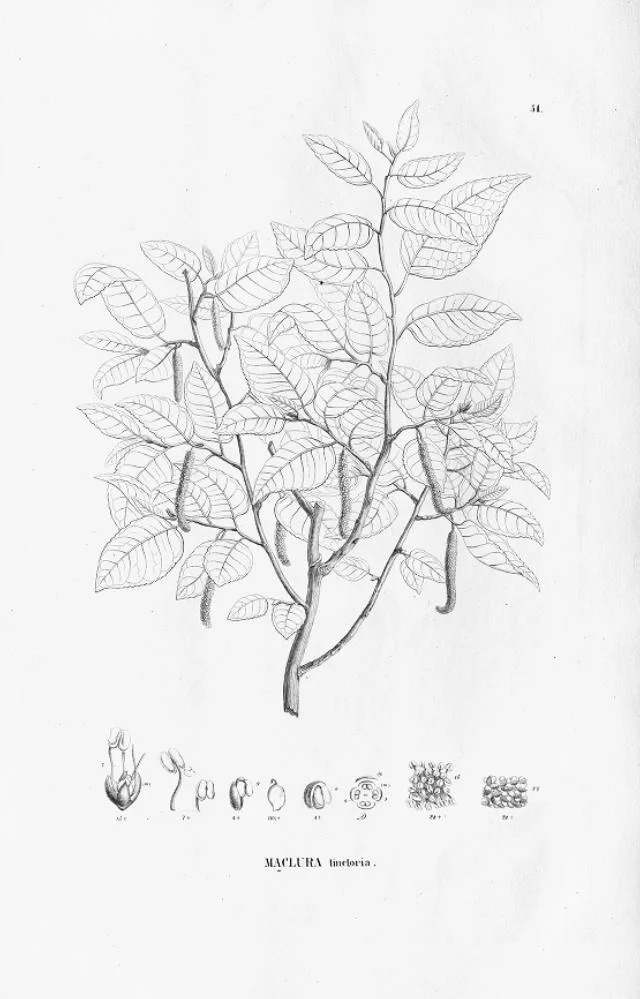
Маклюра красильная
Старый фустик
Желтое дерево
Красильный тутовник
IUCN: Least Concern
#F0F0F0
#ADADAD
#6C6C6C
#6C6C6C
#6C6C6C
Plant palette
Maclura tinctoria: The Historic Dye Tree of the Neotropics
Deep within the sun-drenched, humid canopy of the Neotropics, a tree once held the power to paint the uniforms of entire armies in shades of olive and khaki. Known as old fustic, this remarkable species produces a brilliant yellow dye that defined historical textile industries across the Americas and Europe.
Beyond its famed coloring properties, the timber of Maclura tinctoria is exceptionally dense, heavy, and durable, making it highly valued for heavy-duty construction. The tree also plays a vital role in its native ecosystems, where its sweet, edible fruits sustain local wildlife.
Maclura tinctoria is a dioecious, semi-deciduous tree that can reach heights of 20 to 30 meters, with a trunk diameter of up to 90 centimeters. The trunk is typically short, often showing large buttress roots at the base, and supports an irregular, open canopy. The bark is grey-brown, smooth to scaly, and marked with numerous yellowish lenticels.
The branches and twigs are frequently armed with short, stiff spines and contain a milky white latex. The simple leaves are arranged alternately in two rows along the stems, measuring 5 to 15 centimeters in length. They range in shape from oval to elliptic, with margins that can be entire, serrated, or lobed.
The reproductive structures of this species are highly specialized:
Male inflorescences appear as yellowish-green cylindrical catkins, measuring up to 10 to 12 centimeters in length.
Female inflorescences form solitary, globose heads that are green and measure about 8 to 12 millimeters in diameter.
Sincarps (aggregate fruits) are fleshy, edible, and spherical, changing color from green to red when ripe, and containing numerous small, flat seeds.
Applications
The primary historical and commercial value of this species lies in its heartwood, which yields a highly prized natural dye known as fustic. This dye contains the flavonoid morin and the benzophenone derivative maclurin, producing strong yellow and olive hues. During World War I, it was extensively utilized to dye the khaki uniforms of the United States military.
Depending on the choice of mordant, Maclura tinctoria can produce a wide spectrum of colors:
Old gold is obtained when combined with potassium bichromate.
Olive and dark greens are produced by mixing the extract with copper sulfate or ferrous sulfate.
Saxon greens can be achieved by combining it with indigo or woad.
In addition to its colorants, the extremely hard and heavy wood is used for high-quality veneers, parquet flooring, and local construction. The sweet, fleshy fruits are fully edible, and the leaves are sometimes used to feed silkworms.
Interesting facts
In the Guarani language, this tree is vividly known as tatajyva, which translates to "arm of fire" due to its bright yellow wood and the fiery color of the dye. This name reflects the deep cultural integration of the plant in indigenous South American history long before European colonization.
Although it is often called "old fustic," it should not be confused with "young fustic" (Rhus cotinus), a distantly related Eurasian shrub that produces a much less color-fast dye. The dye from Maclura tinctoria remains famous for its exceptional color-fastness when properly mordanted.
The tree exhibits remarkable ecological adaptability across its native range:
It thrives in secondary forests and disturbed areas rather than pristine primary forests.
It shows a strong preference for calcareous soils, though it easily tolerates sandy alluvial soils and brief seasonal flooding.
Its height and growth form vary dramatically from a small thorny shrub to a massive canopy tree depending on local moisture levels.
Uncover why the silk floss tree develops sharp trunk thorns. Explore prehistoric megafauna defense, green bark photosynthesis, and practical landscape care tips.
Explore the exceptional density, natural yellow dye properties, and woodworking secrets of Maclura tinctoria wood. Master seasoning, cutting, and finishing.
Discover the unique Maclura tinctoria fruit. Learn about its edible syncarp pulp, traditional medicinal uses, seed propagation, and sustainable foraging tips.