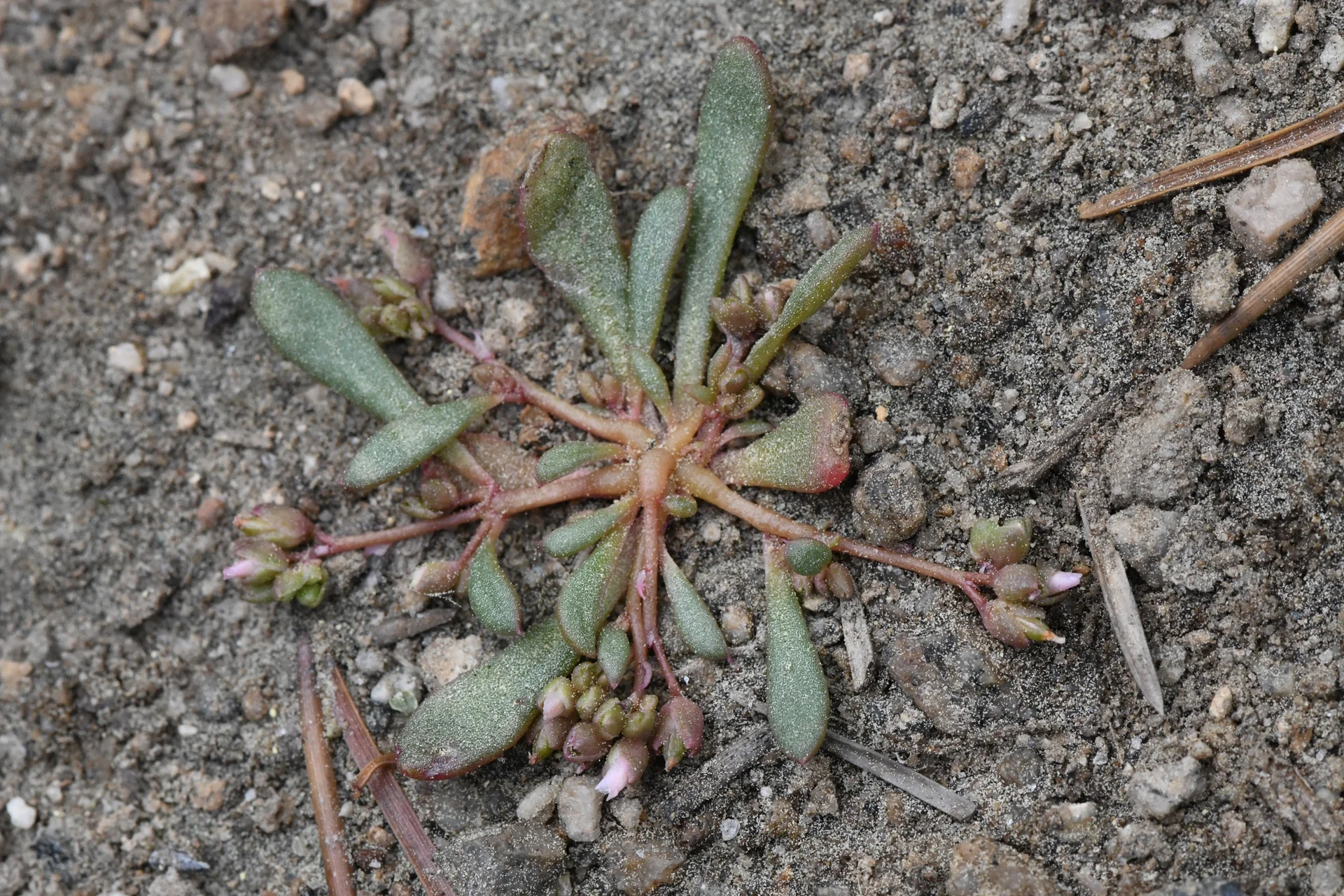
Inhabiting the high-elevation scree slopes of California's mountain ranges, this tiny annual herb forms prostrate, rosette-like mats. Calyptridium pygmaeum thrives in rocky, nutrient-poor alpine and subalpine zones where few other plants can survive. Its miniature growth form allows it to withstand extreme temperature fluctuations and intense solar radiation.
This species plays a subtle yet important role in stabilizing gravelly mountain soils. Its presence is highly localized, making it a subject of interest for montane ecologists studying alpine plant resilience.
The physical structure of this species displays extreme adaptations to alpine environments. Its leaves form a tight, flat basal rosette that hugs the soil surface to avoid harsh winds. The individual blades are spoon-shaped or spatulate, fleshy, and measure between 5 and 15 millimeters in length.
Key reproductive features include:
Stems: Multiple prostrate stems radiate from the central rosette, rarely exceeding 5 to 8 centimeters in length.
Inflorescence: Short, compact, helicoid clusters containing tiny flowers that bloom close to the foliage.
Sepals: Two persistent, unequal, kidney-shaped sepals that enclose the fruit, often displaying translucent or pinkish margins.
Petals: Four minute, white petals that dry quickly and are often smaller than the prominent sepals.
Seeds: Tiny, black, and highly polished, allowing them to remain dormant in the soil seed bank during harsh winters.
Flowering season
Summer (June to August)
Jan
Feb
Mar
Apr
May
Jun
Jul
Aug
Sep
Oct
Name
Dec
Interesting facts
Botanists study this diminutive wildflower to understand the evolutionary mechanisms of survival in alpine scree. The persistent, papery sepals act like protective shields, insulating the developing seeds from freezing night temperatures. Additionally, the prostrate growth habit helps the plant absorb and retain warmth radiated from the surrounding rocks during the brief mountain summer.
Geography of distribution
California
Sources
POWO: Verified entry for Calyptridium pygmaeum under the accepted genus.
GBIF: Occurrence records confirming endemic status in California high mountains.
WFO: Taxonomic details and baseline morphological description.