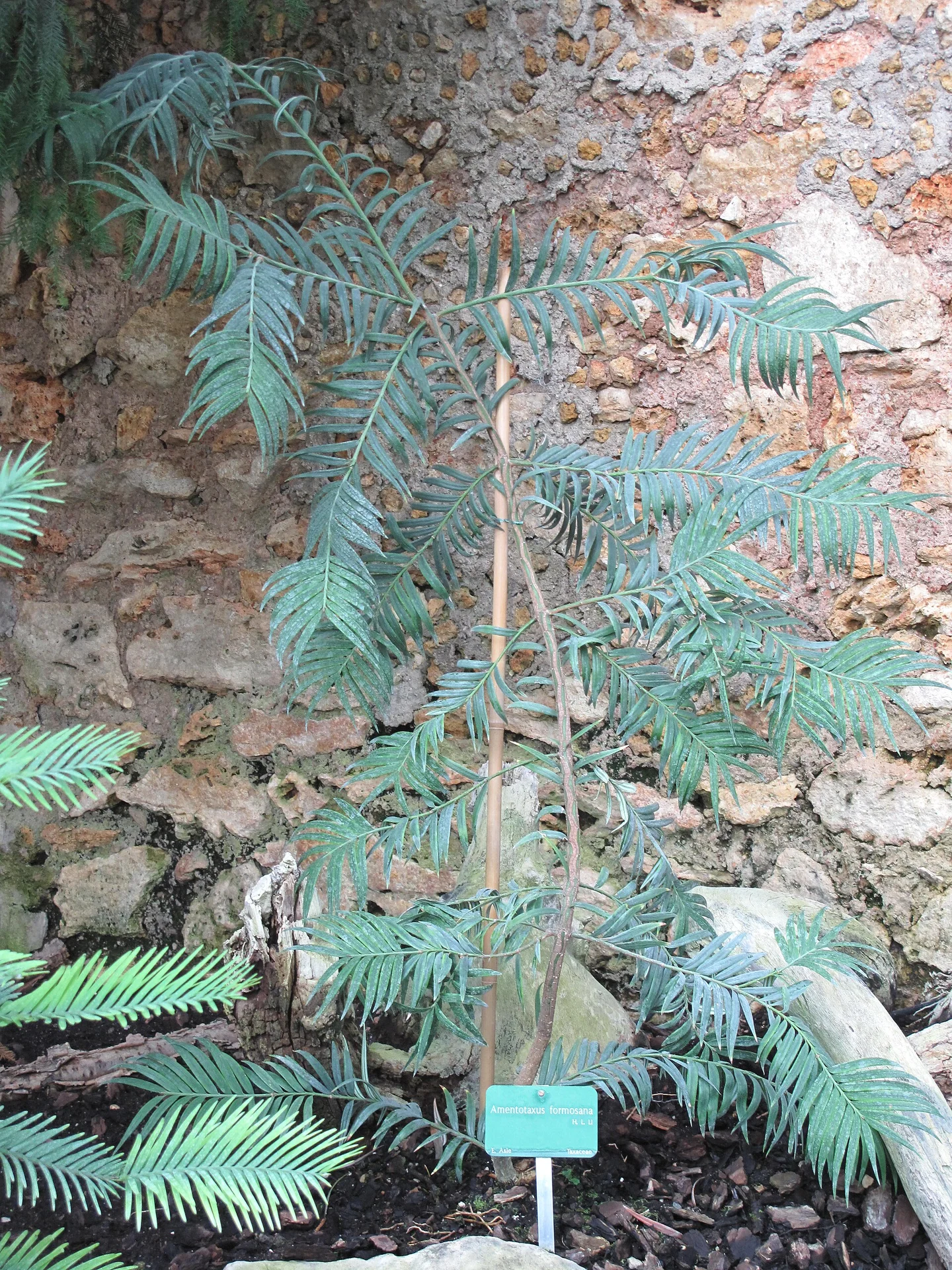
Clinging to the misty, precipitous ravines of the Hengchun Peninsula in southern Taiwan, a rare conifer thrives in the deep shade of subtropical cloud forests. This gymnosperm, known as Amentotaxus formosana, remains a living relic of the Tertiary period, preserved in only a few isolated mountain refuges.
With its elegant, drooping branches and glossy, needle-like leaves, the tree stands as a remarkable representative of the taxad family. Today, its survival hangs in a delicate balance, as less than a thousand mature individuals continue to endure in their highly restricted wild habitat.
Though sometimes sought after by botanists and collectors for its striking ornamental appeal, the species grows at an exceptionally slow rate. Its scarcity in commerce and the wild makes every surviving grove an ecological treasure of global significance.
Amentotaxus formosana grows as a slow-growing, evergreen small tree or shrub, typically reaching heights of up to 10 meters. Its slender trunk, which rarely exceeds 36 centimeters in diameter, supports a loose crown of sparse, spreading branches with yellowish-green young shoots.
The distinctive foliage is leathery, lanceolate to sickle-shaped, and arranged oppositely along the branches. The upper leaf surface is dark green and glossy with a prominent midrib, while the margins are slightly revolute.
Stomatal Bands: The underside of each leaf features two conspicuous, yellowish-white bands of stomata, measuring about 2 millimeters wide and containing around 30 dense rows.
Petioles: The leaves are almost stalkless, attached by a short, thick petiole of just 1 millimeter.
As a dioecious species, this conifer develops male and female reproductive organs on separate individuals, showcasing specialized structures for wind pollination:
Male Strobili: The male pollen cones are arranged in hanging, catkin-like clusters of 4 to 8 spikes, measuring up to 3.5 centimeters long at the tips of young shoots.
Female Seed Cones: The female structures arise singly on drooping stalks from leaf axils. When mature, the seed is enclosed in a fleshy aril that turns reddish-yellow or reddish-violet, leaving only the apex exposed.
Flowering season
Pollen shedding and cone receptivity occur in early April.
Jan
Feb
Mar
Apr
May
Jun
Jul
Aug
Sep
Oct
Name
Dec
Applications
Historically, the dense and durable wood of Amentotaxus formosana has been highly prized by local craftsmen in Taiwan. Despite the tree's modest size, the timber was traditionally harvested to produce high-quality furniture, household utensils, agricultural tools, and decorative woodcarvings.
In horticultural circles, the species is occasionally cultivated as a rare ornamental specimen in East Asia. Its striking foliage, marked by bright silvery-white bands on the undersides of the leaves, makes it a desirable addition to specialized gardens.
However, wide-scale cultivation remains severely limited by the lack of commercially available seeds and cuttings. Furthermore, the species is highly sensitive to frost, restricting its growth to frost-free subtropical and tropical climates.
Interesting facts
The discovery of Amentotaxus formosana dates back to 1893, when Irish botanist Augustine Henry collected the first specimens. Working at the Kaohsiung customs port, Henry enlisted the help of Eluanbi lighthouse keeper Schmüser and local residents to gather rare flora across the rugged Hengchun Peninsula.
Taxonomic Revision: For decades, the tree was classified under the mainland species Amentotaxus argotaenia. It was recognized as a distinct, endemic species in 1952 by botanist Hui-Lin Li, who noted differences in leaf morphology.
Slow Maturity: The species exhibits an extremely slow growth rate, taking at least 20 years to achieve a trunk diameter of only 5 centimeters. Mature trees with trunk diameters exceeding 30 centimeters are frequently hollowed out by rot, leaving them vulnerable to storm damage.
Genetic Vulnerability: Modern genetic analyses reveal that the remaining wild populations suffer from exceptionally low genetic diversity, which impairs their capacity to adapt to changing environmental pressures.
Strict Conservation: To prevent extinction, Taiwan designated the species as a protected plant. The 86-hectare Tawu Amentotaxus Nature Reserve was established in 1988 to safeguard its primary habitats from logging and development.